

Lumbini, the birthplace of Lord Buddha is one of the most important spiritual sites in the world. It is one of the four major pilgrimage sites of Buddhism based in Buddha’s Life. The place, located in the western Terai of Nepal is one of the most visited places of Nepal where not only Buddhist but also people of other faith are attracted.
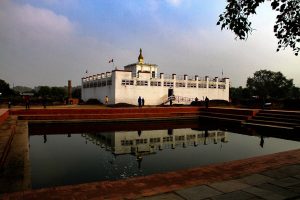
The Lumbini garden covers the area of 4.8km x 1.6 km. It encompasses three zones,
The Sacred Garden:
The Sacred Garden consists of a historical monument and objects of high archaeological values. Mayadevi temple, Ashoka Pillars, Sacred pond and many other structural ruins are located in this zone.
The Monastic zone:
The Monastic Zone is divided into East Monastic zone and West Monastic zone. The East Monastic zone represents the Theravada school of Buddhism and has Theravada Biharas whereas the west Monastic zone has Mahayana and Vajrayana Monastries.
The New Lumbini Village
The New Lumbini Village include administration complex, visitor information system, hotels, Lumbini Museum, Lumbini International Research Centre etc.
Here is the list of the major attractions of Lumbini
Mayadevi Temple
Mayadevi Temple is the most popular attraction of Lumbini, where, Mayadevi gave birth to Lord Buddha. Queen Mayadevi was travelling to her parent’s home to give birth to a child, on the way she rested in this place and gave birth to Buddha. According to legend, the newly born prince Shiddartha walked his first seven steps and in each step, a lotus flower appeared in the ground.
Ashoka Piller
Ashoka Piller was built in 3rd century BC by great emperor Ashoka when he visited the Lumbini. The Pillar is one of the major attraction of Lumbini. The inscription in the Pillar describes his visit and birthplace of Lord Buddha.
The Puskarini Pond
Puskarini Pond is the sacred pond where Mayadevi had a bath before giving birth to Siddhartha and also the first purification bath of infant Lord Buddha. The pond is in the south-west of Mayadevi temple whose present size is 24.90mx24.85mx4.83m.
Lumbini Museum
Lumbini Museum is one of the major attraction of Lumbini which displays about 12000 artefacts. You can observe various metal scripture, religious manuscript, terracotta, coins and stamps in the museum.
World Peace Flame
Eternal peace flame, located in the centre of Lumbini is a symbol of the undying effort to create peace and harmony in the world. The 24 hours glowing flame was created in 1986 for the celebration of the international year of peace.
World Peace Pagoda
The White World Peace Pagoda, located outside the main compound of Lumbini was constructed by a Japanese Buddhist.
Myanmar Golden Temple
Myanmar Golden Temple, constructed in Burmese style architecture is one of the oldest structure in the compound. There are three prayer halls inside the building.
Korean Temple (Dae Sung Shakya)
The Korean Temple has a structure of Korean style architecture. You can stay here for a few days at minimal cost with three meal per day.
You can find many other attractions such as China temple, Srilankan Monastry Cambodian Monastry, Dharma Swami Maharaja Budha Bihar, Royal Thai Buddhist Bihar and many more. There are 32 Buddhist Monastry in Lumbini masterplan areas.
Sites outside Lumbini Garden
There are 62 archaeological sites outside the Lumbini Garden related to Buddha. Some of the major sites are:
Tilaurakot
Tilaurakot is the capital of the ancient Kapilvastu Kingdom. This is the palace where Siddhartha (Buddha) spent his early 29 years of life before renouncing worldly life. The site is located 27 km west of Lumbini. Buddha visited this place several times in his life.
Devdaha
Devdaha, the capital of ancient Koliya Kingdom is the hometown of buddha’s Mother Mayadevi, His Step Mother Prajapati and his wife Yasodhara. Buddha visited this place and ordained Jain Sadhu Nirgrantha Nathputra after seven years of his enlightenment. Devdaha is located 54 km east of Lumbini.
Ramgram
Ramgram Stupa is another important site related to buddha containing one of 8 astadhatu (relics) of the buddha. The relics were divided and distributed to eight kingdoms and each kingdom buried the relics in their stupa. It is the only stupa where Buddha’s relics were put after the cremation and never opened. King Ashoka wanted to open it but the snake god did not permit him.